
Sep 11, 2026
Aluminium Honeycomb Panels for Facade
When you're sourcing facade materials that deliver real performance without adding dead weight to your building structure, the aluminium honeycomb sandwich panel stands out as an engineering solution that solves multiple challenges at once. These composite panels feature two thin aluminium skins bonded to a lightweight honeycomb core, creating a rigid structure that resists bending, withstands coastal corrosion, and maintains its flatness over decades of outdoor exposure.
Understanding Aluminium Honeycomb Panels for Facade
What Makes This Structure Unique?
The triangular core shape of honeycomb panels, which is based on nature, makes them look beautiful. This design takes ideas from nature's most useful building shapes and uses them to spread stress evenly across the panel surface. The end result is a material that feels solid underfoot but doesn't weigh nearly as much as other facade options.
In the manufacturing process, aerospace-grade glue are used to carefully attach 3003 or 5052 aluminum alloy skins to the honeycomb core. This method makes sure that the binding strength stays the same and stops delamination, which is a frequent way for cheaper composite systems to fail. Before leaving the factory, each panel is put through strict flatwise tensile testing according to ASTM C297 standards to make sure the bond is strong (Hexcel Corporation, 2021).
Core Performance Advantages
Because these panels are strong for how light they are, they change how architects and engineers design curtain walls. A normal 20 mm thick panel with aluminum covers weighs about 5 to 7 kg/m², but it can withstand wind loads of up to 8000Pa, which means it can be used for tall buildings in places where typhoons are common.
The thermal efficiency is also very good. The air spaces inside the honeycomb core act as natural insulators, lowering the heat conductivity to about 0.08 W/m·K. Building owners can meet strict energy codes in North America and Europe while cutting HVAC costs with this feature.
In modern construction, fire safety is a must. Under EN 13501-1 testing guidelines, aluminum honeycomb panels get a Class A2 grade for not being flammable. This gives builders peace of mind when choosing materials for high-occupancy buildings (European Aluminum, 2020). Because it's made of only aluminum, there is no organic core material to feed fires or make toxic smoke when it's exposed to fire.
These panels stand out in seaside and industrial settings because they don't rust. The 5052 alloy has more magnesium, which forms a protective oxide layer that can withstand being exposed to salt spray for 1000 hours or more in accelerated weathering tests according to ASTM B117. We've seen installations in port cities in the Middle East keep their look after 15 years of being exposed to the sea all the time.
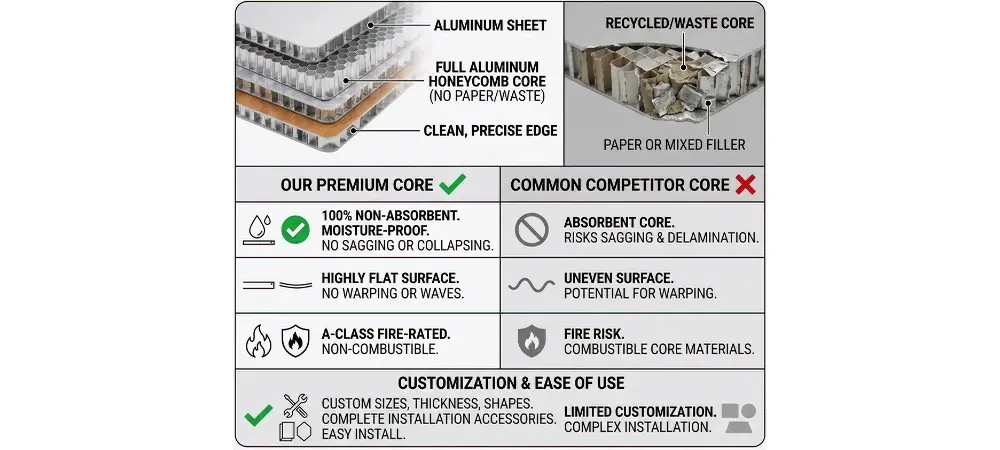
Comparison of Aluminium Honeycomb Panels with Other Facade Materials
Weight and Structural Performance
For wall use, traditional solid metal sheets need to be 3–5 mm thick to be rigid enough, which makes panels that weigh 8–15 kg/m². That number goes up even more with steel composite panels. The honeycomb option is just as stiff, if not stiffer, and weighs almost half as much. This means that the building frame and base don't have to carry as much weight.
This weight advantage of Aluminium honeycomb sandwich panel directly affects how quickly and easily it can be installed. Crews can move bigger pieces of paneling without using cranes, which cuts down on work hours and safety risks on the job site. The cost of shipping goes down by the same amount, since a full container holds more square meters of covering than larger options.
Durability and Maintenance
Plywood pieces soak up water and shift with the seasons, so they need to be replaced every 5 to 10 years. Aluminum foam panels have weak spots where the cells are not arranged evenly, which makes the panels less durable. The honeycomb structure stays the same size when temperatures change from -40°C to +80°C, and there is no discernible deformation after thermal cycling tests.
With honeycomb facades, maintenance intervals are much longer. When PVDF covering systems are put on the metal skins, they protect against UV damage and chalk formation, so the color stays the same for 20 to 25 years without having to be repainted. A simple pressure wash every couple of years is usually enough to bring back the original look.
Thickness Variations and Their Impact
The insulation value and load-bearing ability are both directly related to the thickness of the panel. Standard stock ranges from 6mm to 20mm, and custom fabrication up to 50mm is possible for specific uses that need better blast protection or sound dampening.
Thermal breaks and sound absorption are naturally better in thicker panels. A 25 mm panel can reduce sound by 30 dB, which makes it perfect for hospitals and hotels near busy roads. The trade-off is a little more weight and cost of materials, but the honeycomb structure makes both of those things more doable than solid options.
How to Choose the Best Aluminium Honeycomb Sandwich Panel for Your Facade Project?
Evaluating Technical Requirements
First, write down the load conditions for your project. Calculations of wind pressure tell us what the minimum panel thickness and bond strength needs to be. For projects along the coast, you need 5052 alloy skins with marine-grade PVDF finishes. For projects in the middle of the country, 3003 alloy and standard powder coating may be enough.
Fire codes are different in each area and for each building height. Make sure that the panel supplier has the right third-party certifications for your area. For example, ISO 9001 is needed for quality management, CE marking is needed for European markets, and specific ASTM test reports are needed for North American projects. These licenses are more than just pieces of paper; they show that performance data from approved labs has been checked (American Architectural Manufacturers Association, 2019).
Needs for insulation depend on the temperature zone and the energy goals. To make sure you're following ASHRAE 90.1 or local building energy standards, you need to figure out U-values based on panel thickness and skin material. We've found that 15mm panels work well for most business needs in mild climates, while 20mm to 25mm panels work better in harsh climates.
Identifying Reliable Suppliers
When buying in bulk, the difference between good suppliers and great ones becomes clear. Don't just look at unit prices; also look at the overall value. When you're in a hurry to finish decorating a 50-story building, monthly production ability is important. Suppliers with dedicated aluminum extrusion facilities and long-term contracts for raw materials can keep quality standards and delivery dates even when the market is unstable.
Certification depth shows how mature the manufacturing process is. In addition to basic ISO 9001, you should also look for environmental management systems (ISO 14001), safety licenses for workers, and proof that the product has been tested. Ask for rising drum peel test results (ASTM D1781) that show real bond strength numbers, not just "pass" marks (Aluminum Association, 2021).
Being close to major ports lowers the cost of shipping Aluminium honeycomb sandwich panel and the chance of damage during transport. We work with companies in central China that can quickly get to the ports of Shanghai and Ningbo. This cuts the time it takes for ocean freight to arrive by 5–7 days compared to plants in the interior of China.
Balancing Specifications with Budget
Custom sizes bigger than 1220mm x 2440mm or 1220mm x 3000mm add to the cost of the tools but get rid of waste on the job site when dealing with odd building shapes. Figure out the real cost per fixed square meter by including the cost of cutting and the time it takes to make changes in the field.
When you commit to a certain amount, you can get big savings of scale. We've gotten price cuts of 15-20% for clients who combine multiple parts of a project into a single buy order. Suppliers who have their own coating lines can also match custom colors without charging extra like most third-party finishers do.
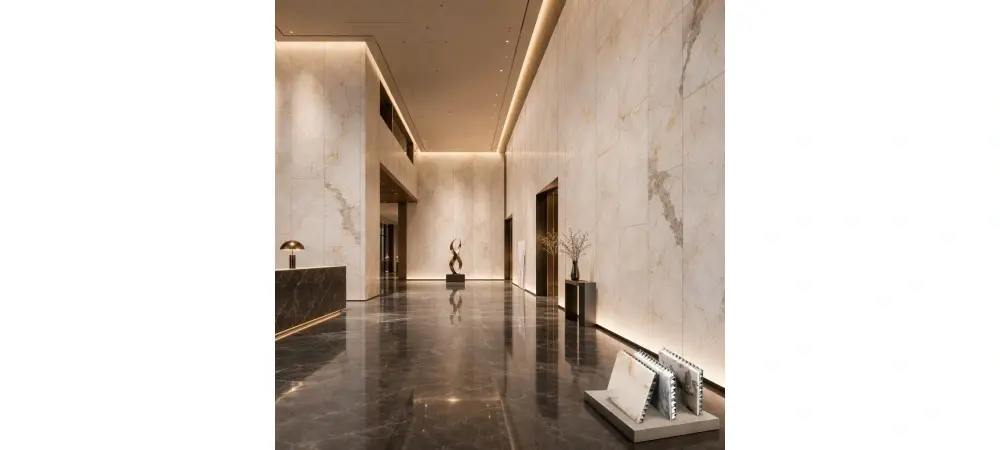
Installing Aluminium Honeycomb Sandwich Panels on Facades
Preparation and Mounting Techniques
Long-term success depends on how well the substrate is prepared. To keep stress from building up at the fixing places, the supporting framework needs to be flat within 2 mm over 3 meters. In coastal areas, only use stainless steel fasteners to stop galvanic corrosion between metals that are not the same.
Different ways of attaching panels depend on how the building moves and how it looks. Hidden clip systems let materials expand and contract with temperature changes while keeping sightlines clear. When there is a lot of wind, mechanical fastening through holes that have already been made works well because it spreads point loads across strengthened areas inside the honeycomb core.
Pay close attention to the details of sealing and flashing. Silicone-based structural sealants keep their flexibility in a wide range of temperatures and keep the weather out at panel joints. Edge sealing done at the factory keeps wetness out of the honeycomb core while it is being handled and installed.
Transportation and On-Site Handling
Panels are shipped on pallets with edge protection and moisture shields so they can be stored outside for a long time. To keep the surface from getting damaged, unload with nylon slings instead of chains. Stack panels horizontally on dry, level surfaces with spacers between each layer to keep them from getting damaged when they touch.
We suggest keeping things in storage for as little time as possible on-site to reduce UV exposure before installation. The PVDF coatings don't break down easily, but protective films work best when they are taken off within 60 days of being put on. Align deliveries with the pace of installation to cut down on traffic on the job site and the risks that come with moving heavy things.
Real-World Project Validation
Luxury hotel projects in Dubai and Southeast Asia have shown that honeycomb wall systems can look good in a lot of different ways. One 42-story building in Singapore asked for custom bronze-tone PVDF finishes on 15mm panels. This gave the building the textured metallic look that the architect wanted and met the Class A fire rating requirements of the developer. The installation was finished in eight weeks, which is three weeks faster than the original plan when using traditional curtain wall parts.
The Aluminium honeycomb sandwich panels can be put up quickly, which is helpful for hospital repair jobs. We provided antimicrobial powder-coated walls for an expansion of a medical center so that building work wouldn't affect areas where patients were being cared for. The thin panels easily attached to existing steel frames without the need for a crane, and the sealed aluminum surfaces made cleaning easier in clean rooms (Healthcare Facilities Today, 2022).
Procurement Guide: Buying Aluminium Honeycomb Panels for Facade
Sourcing Strategy and Supplier Selection
There are still not many true honeycomb core panels available in the United States. This means that most projects have to source them from other countries. Chinese makers make most of the world's goods. They have well-developed supply lines, low production costs, and decades of experience processing metal.
The smallest amount you can order is usually between 500 and 1000 square meters, but some suppliers are flexible enough to do smaller runs of prototypes to make sure the design works. As part of our procurement programs, clients can order standard sizes for instant needs while custom color samples are being made at the same time. This keeps key path schedules from getting behind.
Understanding Pricing Components
Base material costs change with the price of aluminum, but they are usually between 20 and 40 percent of the price of a final panel. The amount of material used and the cost per unit are affected by the thickness of the skin, the choice of metal, and the size of the honeycomb cells. A 0.5mm skin thickness is about 30% less expensive than a 0.8mm skin thickness, but it is less resistant to dents in places with a lot of foot traffic.
The finishing of the surface is another big cost driver. Standard polyester powder coating is the least expensive choice for use inside or in warm conditions. With a PVDF liquid covering, the panels will last 20 to 30 years outside, which will increase their cost by 25 to 35 percent but save money on painting costs over the life of the building.
Custom manufacturing, which includes CNC routing for curved sections, edge folding, and the integration of custom fasteners, adds work that is equal to how complicated it is. When these services get rid of the need for field modification work and shorten installation time, they become cost-effective.
Delivery and Partnership Considerations
It takes 25 to 35 days for ocean freight to travel from Asian ports to major U.S. gateways, plus time for customs clearance and distribution within the country. We allow 45 to 60 days for total lead times from purchase order to delivery on the job site. We also allow for faster air freight on rush parts when project schedules need to be sped up.
Both production flaws and efficiency guaranties should be covered by the warranty. Suppliers with a good reputation back up their goods with 10-year guarantees that cover delamination, coating failure, and rust perforation. This promise shows faith in the quality control methods and products used in manufacturing.
When problems happen in the field, after-sales help is most important. When there are problems during installation, responsive suppliers offer technical help, replace panels that were damaged during construction, and keep standard profiles in stock for future growth phases. We've formed partnerships with people who see each job as the start of a long-term connection rather than a one-time deal.
Conclusion
Aluminium honeycomb sandwich panels offer a great mix of structural strength, environmental durability, and ease of installation that meets the main concerns of building material suppliers, construction companies, and project developers. The technology has been used for decades in harsh climates around the world and has been backed by strict testing standards and third-party certifications. When looking at different facade options, honeycomb construction is a good choice because it is lightweight, rigid, and resistant to corrosion. It also has measurable benefits in terms of both initial costs and long-term value. The key is to work with providers who keep quality high by using integrated manufacturing, clear licenses, and reliable shipping systems.
FAQ
Why do honeycomb panels outperform solid aluminum for facades?
The honeycomb core spreads the load across the whole panel surface like thousands of tiny I-beams. This stops the oil-canning effect, which happens when thin, firm sheets buckle when they are heated or pushed by the wind. This gives you better flatness with less material.
Can panels be customized for unique architectural designs?
Of course. With CNC routing, you can make curved profiles, complicated cutouts, and three-dimensional shapes without weakening the structure. We have made panels with built-in air grilles, radius corners for column wraps, and unique perforation patterns that look good and work well.
How does thickness selection affect thermal performance?
More air is trapped inside the honeycomb cells of thicker panels, which makes them more insulating. A 20mm panel has about 40% better heat protection than a 10mm panel of the same size. Because of edge effects, the relationship isn't exactly linear, but the trend stays the same for thicknesses between 6 and 50 mm.
What maintenance do these facades require?
In most places, regular cleaning every 12 to 24 months keeps things looking good. Don't use rough cleaners on PVDF surfaces; instead, use light soap and soft brushes. Check the areas where sealer is used once a year and reapply it as needed, usually every 7 to 10 years. The aluminum structure doesn't need any work done to it.
Partner with ZX for Your Next Facade Project
ZX connects people who import building materials with people who work in construction, finding approved aluminum honeycomb sandwich panel options that fit your project's exact needs. Because we work with Zhengzhou's top aluminum decorative materials manufacturer, we have direct access to more than 300 custom molds, full ISO 9001 and CE certifications, and enough monthly production capacity to meet the needs of large hotel and commercial developments on time.
We can make changes to the sizes, finishes, and performance requirements of your panels, from normal 1220mm x 2440mm panels to larger sizes that match your building plans. Our strict six-step quality control process before shipping keeps problems to a minimum and makes sure that every panel meets the performance standards that your business depends on. We've successfully completed high-end projects in Dubai and Southeast Asia, and our outdoor service life guaranties last for 20 to 30 years.
Our team responds within one business day, whether you need quick quotes to help you plan your budget or sample panels to get approval for testing. Get in touch with our experts at info@kangdishi.com to talk about your facade needs and find out why smart buyers choose ZX as their Aluminium honeycomb sandwich panel supplier for projects that require dependability, sustainability, and engineering expertise. You can look at all of our architectural metal options at zhongxiudecor.com.
References
1. Aluminum Association. (2021). Aluminum Design Manual. Washington, DC: The Aluminum Association.
2. American Architectural Manufacturers Association. (2019). AAMA 501.6 Recommended Static Test Method for Evaluating Curtain Wall and Storefront Systems Subjected to Seismic and Wind Induced Interstory Drifts. Schaumburg, IL.
3. European Aluminium. (2020). Fire Safety of Aluminium Facades. Brussels: European Aluminium Association.
4. Healthcare Facilities Today. (2022). "Advanced Building Materials Improve Hospital Construction Efficiency." Healthcare Facilities Today, Vol. 28(3), pp. 14-18.
5. Hexcel Corporation. (2021). HexWeb Honeycomb Sandwich Design Technology. Stamford, CT: Hexcel Corporation.
6. ASTM International. (2018). ASTM C297/C297M-16 Standard Test Method for Flatwise Tensile Strength of Sandwich Constructions. West Conshohocken, PA.
Online Message