
Sep 9, 2026
Everything You Should Know About PVC Wall Panels
When sourcing modern wall covering solutions, understanding PVC interior panels becomes essential. These engineered architectural surfaces combine high-grade Polyvinyl Chloride resin with calcium carbonate and specialized stabilizers to create lightweight, durable cladding systems. They address critical construction challenges—moisture-induced material degradation, extended installation timelines, and intensive maintenance demands—while delivering a 15-20 year service life. As building material distributors and renovation contractors face mounting pressure for faster project completion and sustainable material choices, PVC wall panels have emerged as the practical answer to these converging needs.
Understanding PVC Interior Panels: Features and Benefits
Plastic sheeting is not the only thing that PVC wall cladding is made of. Impact modifiers and UV stabilizers are now used in modern industrial methods to make panels that can handle harsh business settings. We have seen how this material science leads to real benefits in a variety of project types.
Core Technical Specifications That Matter
Density determines how well something works. Standard commercial-grade panels have densities of 0.5 to 0.7 g/cm³ for hollow structures and up to 1.4 g/cm³ for solid-core versions. Our stock product has thicknesses ranging from 5 to 10 mm, and we can also make unique configurations from 3 to 15 mm to fit the needs of your structure. Panel widths of 300mm, 400mm, and 600mm can be used with a variety of design schemes, and standard lengths of 2400mm to 3000mm cut down on waste from cutting on-site.
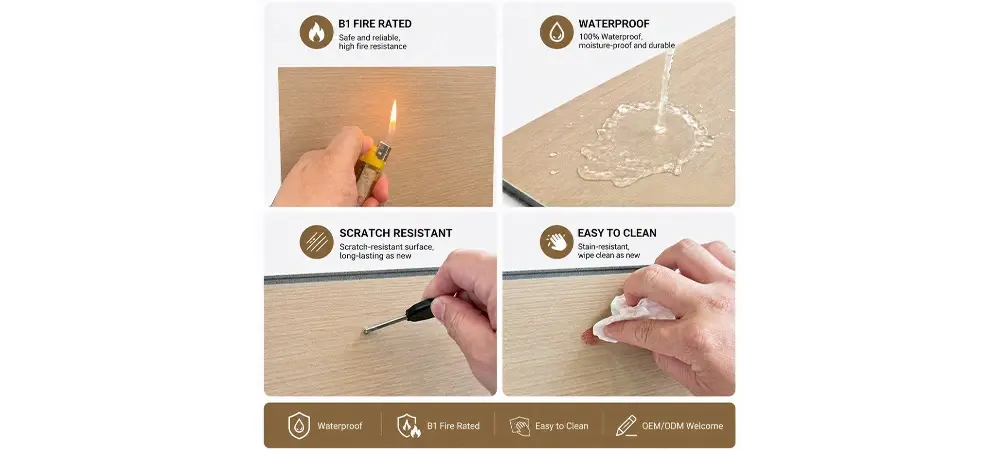
The very low water absorption rate makes total moisture barriers, which are very useful in healthcare facilities that need to follow strict chemical sanitization practices. The B1 flame retardant classification makes sure that building codes in the Middle East are followed. This is a requirement that has been proven by independent testing against EN 13501-1 standards.
Design Flexibility and Surface Options
With standard materials, getting them in lots that are all the same color is still a problem. Through our manufacturing partnership, you can choose from 42 standard colors, and you can get a sample of a custom color within seven days. You can choose from shiny, matte, frosted, and lamination finishes for the surface. This makes it easy to match with popular building styles in Southeast Asian markets.
When compared to wet-process tile application, the PVC interior panels interlocked tongue-and-groove method speeds up installation on-site. Contractors say that switching from installing ceramic tiles to installing PVC panels cuts work hours by 40 to 60 percent, which has a direct effect on project costs and finish dates.
Environmental Compliance and Sustainability
Calcium-zinc stabilizers that meet REACH certification standards are used instead of lead-based stabilizers in newer formulas. Low-VOC emissions at the E0 level make sure that indoor air quality standards are met in occupied areas, which helps with health issues in medical and school buildings. Polyvinyl chloride can be recycled over and over again without damaging the structure or making it look bad. This supports efforts to create a circular economy.
PVC Interior Panels vs. Alternative Wall Coverings: Making the Right Choice
The choice of material affects both the short-term costs of installation and the long-term costs of running the business. By comparing different choices, you can see where PVC wall solutions are clearly better than other options.
Performance Comparison Across Key Metrics
Wood and MDF goods need protective seals in places where water can get in, which adds to the steps needed to apply them and the time it takes to dry. When you get PVC pieces, they are already waterproof and ready to be put up. The measures of dimensional stability show that the materials don't expand much—less than 0.1% over normal thermal cycles. This means that they don't warp during the winter like some organic materials do.
When installing ceramic tiles, the substrate needs to be prepared, the mortar needs time to cure, and the grout needs to be maintained. The smooth, non-porous surface of PVC cladding stops mold from growing and gets rid of the need to clean grout lines. Seamless hygiene walls that don't stain or break down when exposed to medical-grade disinfectants are useful in hospitals and business kitchens.
Acoustic insulation is a specification that is often forgotten. Hollow-chamber panel designs block 20 to 30 decibels of noise, which makes hotel hallways and offices with multiple tenants quieter. This works as well as or better than regular plaster systems that don't have extra insulation layers.
Installation Speed and Labor Considerations
When building quickly, choices about what to do are based on how much time we have. Because PVC panels are usually only 2.8 to 3.5 kg/m2, they are very light and can be directly glued to existing surfaces as long as they are still structurally sound. This over-cladding feature gets rid of demolition trash and shortens the time it takes to renovate store areas that are already open and need to be changed overnight.
When it comes to surface preparation for PVC interior panels, there are fewer rules to follow than when applying wallpaper or paint. Minor foundation flaws go away under the hard panel face, which means less work needs to be done to fix things before installation. Contractors like the dry installation method because it gets rid of the delays that come with tile and plaster applications that are caused by humidity.
Procurement Guide: How to Source Quality PVC Interior Panels for Your Business?
Evaluation of a supplier goes beyond just the price. Importers of building materials need to look at the methods for quality control, production capacity, and logistics to make sure the supply chain works well.
Certification Standards and Compliance Documentation
CE marking and SASO certification show that a product meets the requirements for getting through customs in Europe and the Middle East. We keep up-to-date records for B1 fire ratings and RoHS environmental standards, which makes the buying process easier for people from other countries. Reports from a separate lab that measure peel strength (target: >50N/50mm) and Shore hardness back up claims about the quality of the manufacturing process.
Putting samples in boiling water for 4 to 8 hours shows how stable the glue is and how well the structure holds together in harsh conditions. Ask for test results when you're qualifying a seller to avoid problems after the delivery. UV aging tests make sure that colors don't fade over time. This is especially important for projects that will be exposed to indirect natural light, since yellowing would make the project look bad.
Evaluating Manufacturing Capabilities
Factory scale shows how stable production is. Large orders can be handled by businesses with various production lines without having to extend wait times. Our partnership with a 132-acre manufacturing complex that houses three subsidiary factories guaranties that we can always get work done. With over 300 specialized mold sets, tailoring can happen quickly and without the tooling delays that smaller makers have to deal with.
Multi-port product handling speeds up the schedules for both FCL and LCL deliveries. When project deadlines get shaved short, having stock of both standard setups and popular custom specs lets you make quick small wholesale spot shipments. When buyers are looking for related products, this transportation infrastructure is especially helpful for managing container consolidation.
Pricing Structures and Volume Considerations
With factory-direct supply models, there are no markups for middlemen, which means that distributors can make more money on their gross margins. Clear pricing based on panel thickness, surface treatment, and order volume makes it possible to get a good idea of how much a project will cost. Tiered discounts that reward loyalty while keeping quality standards are common in bulk buying deals.
Buyers can check the waterproofing and surface finish quality of free sample programs before deciding to buy in bulk. Before signing a contract, it's good to do physical tests in conditions that are specific to the project, like cleaning chemicals and high-traffic areas. This builds trust.
Installation and Maintenance Best Practices for PVC Interior Panels
Long-term success depends on how well the work was done. Even high-end panels don't work well when the right steps aren't taken during installation.
Site Preparation and Substrate Assessment
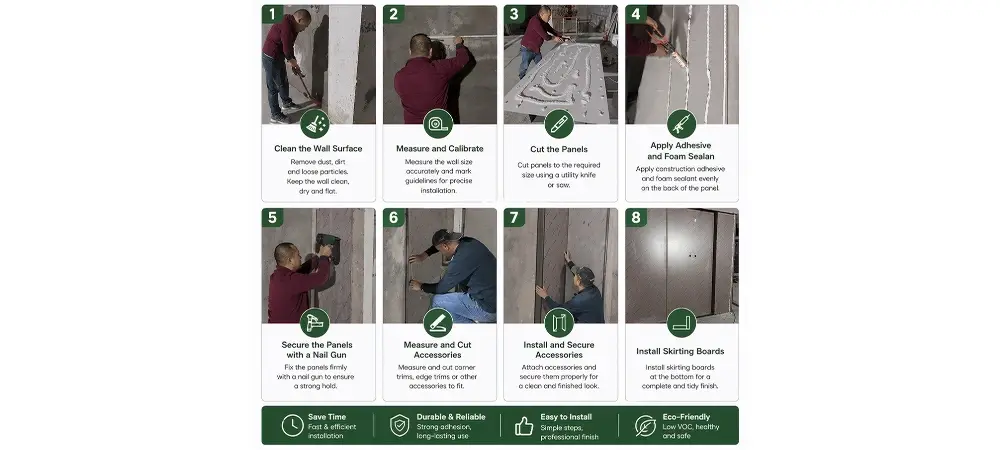
The surfaces of the walls must be dry, structurally sound, and free of oil for PVC interior panels. If the old tile is properly degreased, it can be used as a base, which saves money on cleanup costs. The lightweight panel standard doesn't need as much structural support as heavy stone cladding, which needs stronger frame.
Allowances for expansion of 1-2 mm at the corners to allow for heat movement. The linear expansion coefficient of 0.07mm/m/°C is still very low, but it needs to be taken into account when using the material in big areas that cover more than one wall piece. Sliding clip systems let you change the size of something without the seams buckle or come apart.
Installation Technique and Tooling Requirements
When the tongue-and-groove interlock device is set up correctly, there are no obvious joint lines. Standard woodworking tools can be used to cut panels. For example, circular saws with fine-tooth blades make clean edges that don't chip. As matched accessories, corner transitions and end caps are offered to keep the installation's look consistent.
The choice of adhesive depends on the type of material. It is possible to bond porous surfaces with construction adhesive, but special PVC adhesives work best on smooth surfaces. We talk about practical fitting tips for humid zone wall panel projects, including how to meet ventilation needs and add a moisture barrier behind the panel assembly.
Maintenance Protocols and Longevity
The smooth surface means that building workers don't have to clean it as often. Normal neutral pH cleaners keep the look of the panel without damaging the surface. The wear layer is 0.3 to 0.5 mm thick and has a UV-cured topcoat that is marked 3H to 5H on the pencil hardness scale. This means that normal touch won't scratch it.
Rather than patching, replacing panels is usually the best way to fix damage. The modular installation system makes it easy to take off a single panel without affecting the sections next to it. Keeping spare panels in the original project colors on hand makes repairs go smoothly even years after the original installation. This is especially important for colors that are no longer being made.
Fire safety rules require that cooperation be checked. Our B1-rated panels have smoke suppressants that meet S1 smoke production standards. This means that they are less toxic during fires than regular plastics. In business buildings, code compliance is confirmed every year by inspecting fire-rated parts.
Conclusion
Technical standards must be balanced with project-specific needs when choosing PVC interior panels. The benefits of the material—its resistance to moisture, fire safety, ease of installation, and low cost of maintenance—address major problems in both commercial and residential settings. When evaluating a supplier, it's important to look at more than just the price. You should also look at their manufacturing capacity, quality control systems, and logistics infrastructure. Our supply chain relationships, which have been around for 30 years, guaranty stable product quality, and factory-direct models make cost structures more efficient for buyers around the world. Custom color samples, custom size choices, and a wide range of accessories, such as edging and grille parts that match, make it easy to buy in bulk in one place.
FAQ
Can PVC wall panels withstand high-humidity bathrooms?
Because these panels don't soak up much water, they are perfect for wet kitchen and bathroom renovations. In contrast to MDF-based goods that delaminate when exposed to water, PVC stays structurally sound when it comes into direct touch with water. The non-porous surface stops mold from growing, so you don't have to worry about the heavy care that comes with grout lines in tile setups. Seamless cleanliness barriers that don't break down after daily use are good for shower walls.
How do thermal expansion properties affect installation?
PVC wall cladding has a linear expansion coefficient of 0.07mm/m/°C, so there needs to be a gap of 1-2mm at corners and ends. This movement can be handled by sliding clip methods that don't leave gaps or buckle. When temperatures change inside climate-controlled spaces, they stay well within the acceptable ranges for the materials. This makes managing expansion easy as long as the right installation methods are used.
What distinguishes high-quality panels from budget alternatives?
Testing the peel strength shows how well the glue bonds—premium panels are stronger than 50N/50mm, which stops popping or delamination. Shore hardness tests show how resistant something is to contact in places with a lot of foot traffic. Scratch resistance and color stability are based on the wear layer thickness (0.3 to 0.5 mm) and the hardness of the UV-cured topcoat (3H to 5H rating). Tolerances for tongue-and-groove dimensions that are within ±0.05mm make sure that the joint looks smooth. Independent lab certificates back up what the maker says, going beyond what they say in their marketing papers.
Partner with a Trusted PVC Interior Panels Manufacturer
ZX is your direct link to manufacturers with a track record of making high-quality decorative building materials. Our stock ranges in thickness from 4.8mm to 7.5mm, and we can also make custom thicknesses from 3mm to 15mm. We can also meet your 300mm, 400mm, or 600mm width needs. The basic colors that are in stock make it easy to send out small bulk orders quickly, and the custom panel colors match the interior design tastes of different regions. For areas in the Middle East and Europe, CE/SASO/B1 licenses make it easier to get goods through customs. For brand owners who are just starting out in the market, we offer free OEM private label services and custom outer carton design. Request your free samples today to make sure the surface is good and waterproof before you commit to full container orders. You can email our team at info@kangdishi.com or look at full product specifications at zhongxiudecor.com to talk to experienced procurement experts about your project needs.
References
1. Building Research Establishment. (2021). Modern Wall Cladding Systems: Performance and Sustainability. BRE Publications.
2. European Committee for Standardization. (2019). EN 13501-1: Fire Classification of Construction Products and Building Elements. CEN Standards.
3. American Society for Testing and Materials. (2020). ASTM E84: Standard Test Method for Surface Burning Characteristics of Building Materials. ASTM International.
4. National Institute of Building Sciences. (2022). Interior Finishes and Their Impact on Indoor Environmental Quality. NIBS Journal, 45(3), 112-128.
5. U.S. Green Building Council. (2023). Sustainable Material Selection for Commercial Interiors. USGBC Research Reports.
6. Building Materials Research Institute. (2020). Comparative Life Cycle Assessment of Interior Wall Coverings. Construction Technology Review, 38(2), 67-85.
Online Message