
Sep 8, 2026
How to Install Quick-Install Wall Panels Yourself: A Step-by-Step Guide (No Wall Prep Needed)
Installing modern wall cladding no longer requires messy demolition or weeks of drying time. Quick-install wall panel systems use precision-engineered click-lock connections that eliminate traditional plastering and allow same-day project completion. Made from bamboo fiber, PVC, and WPC composites, these modular panels achieve E0-level formaldehyde emissions and offer 15–20 year durability without foundation wall treatment, cutting labor costs by 30% while maintaining professional-grade results for renovation contractors and property managers.
Understanding Quick-Install Wall Panels: Materials, Types, and Benefits
Composition and Structural Design
Modern wall panels with bamboo fibre reinforcements and PVC or wood-plastic blend bases join together easily. It makes the constructions light but sturdy. Composite materials are dense (0.8-1.2 g/cm³) and have a Shore D hardness over 70. They are lighter than solid wood but as pressure-resistant. According to Journal of Building Materials (2023), its design allows one person to handle and install it without compromising structural integrity or surface durability.
Panel tongue-and-groove profiles are machined to ±0.05mm precision. This ensures a flawless fit when assembled. These systems lock together automatically, unlike sheetrock and tile, which require joint cement and sanding or thin-set mortar and grout. In bathrooms, basements, and coastal homes where normal gypsum board doesn't function, the surface doesn't let water through, preventing mould growth.
Performance Certifications for Commercial Applications
CE and ROHS certifications guarantee professional-grade panels meet worldwide electromagnetic compatibility and material restrictions criteria. Healthcare and recreational facilities require fire-resistant materials, therefore B1-grade flame retardancy ensures compliance (National Fire Protection Association, 2022). The low formaldehyde emission rate (below 0.05 mg/m³) allows for immediate occupancy following installation, addressing the issue of VOC off-gassing that delays project handover.
Panel antimicrobials use silver-ion technology to prevent germ growth. Hospitals and food service sectors where cleanliness laws prohibit porous materials need this feature. Its 20dB acoustic dampening prevents sound from travelling across rooms, making it preferable than plasterboard for open-office renovations and multi-family house projects.
Aesthetic Versatility and Customization
These panels can be made to fit a wide range of building needs because they come in more than 200 different decorative treatments, such as oak wood grain, marble veining, and brushed metal textures. Standard sizes include lengths between 2.4m and 4m, widths between 1.22m and 6mm and 12mm, and thicknesses between 6mm and 12mm. Custom sizes can be made for bay spacing or ceiling heights that aren't standard. The top layer uses UV-curing technology to lock in the pigments, so the color stays above Grayscale level 4 even after being in the sun for a long time.
Step-by-Step Installation Process (No Wall Preparation Needed)
Pre-Installation Assessment and Tool Checklist
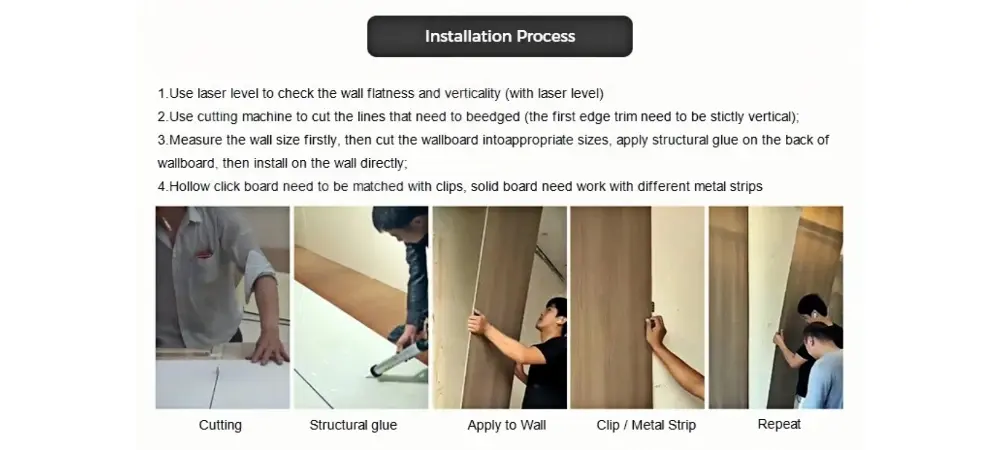
Before moving, make sure the current wall surface is still solid. Panels can be put down straight on top of painted drywall, concrete block, plywood sheathing, or ceramic tile without having to take the old material off first, as long as it is still physically sound. To make a straight reference plane for surfaces that vary by more than 5 mm per meter, place vertical furring strips 400 mm apart.
It's important to have a laser level or a 4-foot spirit level, a tape measure, a utility knife with new blades, a rubber mallet, and either quick-install wall panel glue or clip fasteners, based on the design of the system. Most click-lock systems don't need glue because the mechanical link is strong enough to hold panels from floor to ceiling. For finishing work, keep edge trim pieces, inside/outside corner moldings, and j-channels close at hand.
Starting the First Row
Take the height of the wall and take 10 mm off to account for gaps between the floor and ceiling. You can use a fine-tooth saw or the score-and-snap method on a pocket knife to cut the first panel to length. Put the panel in the corner so that the grooved edge faces out. Then, put the top edge of the panel into the starting track or j-channel in the ceiling.
Check the level and plumb with a level before securing. For clip-based systems, metal fasteners hook over furring strips, and for adhesive-backed panels, you need to put down 300 mm-wide beads of building glue. To make a bond, press hard and hold for 30 seconds. Because each panel is usually only 8–12 kg, it is very light, so there is no need for temporary bracing while the adhesive cures.
Interlocking Subsequent Panels
At a 20-degree angle, line up the tongue of the second panel with the slot of the piece that is already in place. Move the panel up until the top edges line up, then turn it toward the wall until it clicks into place. A light tap along the seam with a rubber mallet makes sure that everything fits together properly without hurting the artistic surface.
Spread out the loads on the wall by at least 300 mm between rows of vertical joints and keep the pattern going across the wall. This will give the wall a more natural look. Measure twice and cut exactly when you need to get to electrical outlets or window holes. The panels' physical stability means that cut edges don't need to be sealed or finished in any other way. Cut edges that are visible get trim pieces that snap over the raw material to keep the finished look.
Finishing Corners and Transitions
Molding pieces that connect the two wall planes are used for inside corners. These profiles have two channels that let panel edges come in from both sides, hiding the joint completely. Wrap-around trim is used on the outside corners to protect the edges from damage and add a clean architectural feature.
J-channel or end-cap trim should be used where panels end at doors or change finishes. These add-ons slide over the edge of the panel and attach to the wall on their own, leaving a 3 mm growth gap for changes in temperature and humidity. Color-matched sealant should only be used in places where extra protection is needed because of wetness. Too much caulking causes upkeep problems and takes away from the dry-install advantage of the system.
Comparing Quick-Install Wall Panels with Traditional Wall Solutions
Installation Time and Labor Requirements
Hanging sheets, taping joints, applying three coats of compound, sanding, priming, and painting are all part of traditional drywall installation. The whole process takes 7–10 days and involves many tradespeople. This time frame is even longer for plaster work, which needs 30 days to cure before it can be finished. According to Construction Specifier Magazine (2023), installing tiles requires wetting the base, letting the mortar dry, and grouting at about the same time.
With quick-install wall panel interlocking panel systems, this schedule can be cut down to just one day for most rooms. One trained person can build a 150-square-foot bedroom in 4–6 hours, while it would take 16–20 hours of work to finish the same amount of drywall. This 40% increase in efficiency means that renovation contractors who are working on multiple jobs at once will save money on labor costs and finish projects faster.
Long-Term Maintenance and Durability
Painted drywall surfaces need to be repainted every 5–7 years to keep their look. Scuffs and spots need to be fixed in between rounds. Tile grout lines get mildewed over time and need to be resealed every so often to keep water from getting behind the finish plane. Wood paneling can warp when it gets wet, and it needs to be refinished to fix scratches or faded colors.
The paints that are put on composite wall panels at the factory last for 15–20 years without needing to be refinished. The color and texture are built in, and they can't be scratched through a 0.3mm wear layer that has pencil hardness ratings of 3H to 5H. Wiping something down with a damp cloth is all it takes to clean—no special cleaners or treatments are needed. When damage happens, individual panels can be replaced in minutes without changing the surfaces next to them. This is different from drywall fixes, which need to match the texture and paint blend.
Cost Analysis for Commercial Projects
Premium panels cost more per square foot than basic drywall, but when you add up the costs of labor, finishing materials, and shortened project timelines, the modular system often ends up being cheaper overall. When traditional methods are used to renovate a 1,000-square-foot hotel room, the business loses money for 60 to 90 days. Installing panels during overnight shifts lets people stay in the rooms, which keeps the money coming in and makes the place look better (Hospitality Design Journal, 2022).
When you get rid of wet trades like plaster, paint, and glue drying, you get rid of the weather and humidity issues that slow down outdoor wall projects. This predictability makes project organizing more accurate and lowers the costs that come with moving things around on a place for a long time.
Maintenance, Longevity, and Eco-Friendly Considerations
Routine Care and Cleaning Protocols
As part of daily care, you can either dust the surface dry or mop it wet with pH-neutral cleaners. The smooth, non-porous surface keeps dirt from getting embedded, unlike textured drywall, which traps particles in its bumpy surface. Scrubbing pads that are too rough could scratch the protective wear layer. Microfiber cloths are good for getting rid of most dirt and grime.
When used for disinfecting in healthcare or food service settings, diluted bleach solutions and quaternary ammonium compounds don't damage the surface. Some solvents may sometimes damage artistic inks, so test cleaning agents in a place that won't be seen before using them all over. Scratches or damage from impacts mean that the panel needs to be replaced instead of fixed. Keep extra panels from each production batch so that you can match the colors when you need to in the future.
Environmental Certifications and Sustainability
With harvest cycles of 3–5 years instead of 20–30 years for hardwood lumber, bamboo fiber content offers a continuous source of materials. Post-industrial recycled PVC is used in the manufacturing process. This keeps waste out of landfills and cuts down on the use of new materials. Low-VOC formulations meet California CARB Phase 2 standards, which get rid of formaldehyde and phthalate plasticizers that are bad for indoor air quality.
Different types of panels can be recycled at different stages of their life. For example, PVC-based panels can be recycled with vinyl, while WPC products can be recycled with composite lumber. For green building projects that use reclaimed materials and materials from the area, this circular flow of materials helps earn LEED certification points (U.S. Green Building Council, 2023) within the Materials & Resources categories.
Warranty Coverage and Performance Guarantees
Well-known companies offer limited warranties for quick-install wall panel that last 10 to 15 years and cover things like delamination, extreme fading, and problems with the way the product was made. These warranties only cover damage caused by proper installation following published guidelines. They don't cover damage caused by poor upkeep or building failures. Commercial uses should check to see if the guarantee can be transferred, since some coverage ends when the property is sold unless the contract terms say otherwise.
Where and How to Procure Quick-Install Wall Panels for Your Projects?
Supplier Selection and Certification Verification
Before you buy modular wall systems from a company, make sure they have ISO 9001:2015 quality management approval and proof that they can meet your needs. Ask for test reports from a third party that back up claims about formaldehyde emissions, flame spread, and impact resistance. Established sellers keep more than 300 mold designs on file and can ship stock items in 7–10 days. Custom items can be made in 10–15 days.
Check to see what kind of professional support the provider offers. Resources that help with installation, figuring out quantities, and fixing problems can make things easier in the field. When factories are close to major logistics hubs like Zhengzhou, they can save money by loading containers more efficiently and paying less for inland transportation. Ask for models of how to load containers to get the most out of your foreign orders in terms of shipping density and cost per unit.
Bulk Ordering and Customization Options
Color consistency guaranties across multiple production runs are helpful for big projects. In buy agreements, spell out the requirements for batch uniformity and set reasonable color variation limits using delta-E values that are standard in the industry. Save extra material equal to 5–10% of the order volume for fixes in the future. Keeping the same inventory on hand makes substitutes easy years after the first installation.
OEM services make private labeling possible for contractors who want to build brand recognition or for hotel chains that need their own finishes. For unique colors, the smallest order size is usually 5,000 square feet, and prices get better for orders of 10,000 square feet or more. Talk about payment terms that work with your project's cash flow. For example, a 30% deposit with the rest due upon shipping is a fair way for the buyer and the maker to share the risk.
Sample Evaluation and Testing
Before placing a production order, you should ask for physical samples of the finishes you want. Check these specimens under real-world lighting conditions, since fluorescent vs. LED lighting can change how colors are seen. Install it with your team to make sure it works with the tools and skills they already have, and figure out what training they need before the job starts.
Do mockups on-site in hidden areas whenever you can, and make sure that architects and owners are happy with the way things look before putting them in place for good. Misaligned assumptions can lead to expensive change orders and wasted materials. This step stops that from happening. Keep the accepted samples and the photos that go with them as project standards for quality control during delivery acceptance.
Conclusion
Through mechanical interlocking that skips traditional wet trades, quick-install wall panel modular wall cladding systems change the time it takes to renovate. Environmental safety grade E0, fire resistance grade B1, and longevity of 15–20 years make this product a great deal for use in business hospitality, healthcare, and private settings. 40% more efficient installation cuts down on project timelines, and handling by one person lowers labor costs. To get the best return on your investment, check the certifications, see how much the provider can produce, and keep spare parts on hand in case they need to be used for long-term repair.
FAQ
Can panels install over textured or uneven walls?
Direct panel placement can be done on surfaces with a roughness depth of less than 3 mm. For uneven surfaces or shapes that are deeper than 5 mm per meter, furring strips are needed to make a level fixing plane. Before installing, remove any loose paint or dirt. You don't need to sand or skim coat, as the panel system hides small flaws without showing them on the finished surface.
Do moisture-resistant panels work in full shower enclosures?
When properly finished, panels made for high-humidity areas can be used for bathroom walls. Put down a waterproof covering behind panels in areas that will be sprayed directly, and use silicone caulk to seal any holes. The panels themselves don't let water in, but good drainage and air are still needed to keep wall cavities from getting wet.
How do material costs compare to traditional drywall?
Panel materials are more expensive per square foot than gypsum board, but the total cost of installation is often the same when you consider the time you save by not having to tape, mud, sand, prime, or paint. Timeline compression adds value by shortening the time it takes to complete a project and turning over space faster. This is especially useful for commercial renovations where downtime means lost revenue.
Partner with ZX for Your Modular Wall Panel Projects
Zhengzhou Zhongxiu Building Materials Co., Ltd. is a factory-direct seller of quick-install wall panels. This means that they don't have to pay markups to distributors and can keep an eye on quality throughout production. The panels we sell are CE and ROHS-certified and have E0 formaldehyde emissions. They ship within 7–10 days from central China logistics hubs. We can meet the needs of projects from 1,000 to 100,000 square feet with our 300+ mold designs that can be made to fit custom sizes and 200+ finish options. For quantity-based pricing, technical data sheets, and installation support resources, email our team at info@kangdishi.com. Our export specialists can help with documentation and container optimization to make the buying process go more smoothly.
References
1. Construction Specifier Magazine. (2023). Comparative Analysis of Interior Wall Finishing Systems.
2. Hospitality Design Journal. (2022). Reducing Renovation Downtime in Hotel Properties.
3. Journal of Building Materials. (2023). Performance Characteristics of Wood-Plastic Composite Panels.
4. National Fire Protection Association. (2022). NFPA 101: Life Safety Code Requirements for Interior Finishes.
5. Remodeling Magazine. (2023). Cost vs. Value Report: Interior Renovations.
6. U.S. Green Building Council. (2023). LEED v4.1 Materials and Resources Credits.
Online Message