
Sep 28, 2026
MDF Wall Panels vs. PVC Panels: Here is What You Should Buy!
If you are sourcing interior wall cladding for commercial or residential projects, the choice between MDF and PVC wall panels directly affects your budget, timeline, and long-term material performance. Based on my procurement experience, PVC interior panels consistently outperform MDF in moisture-prone, high-traffic, and safety-regulated environments. However, each material holds its own ground depending on the application. This guide breaks down both options with honest, data-backed insights so your next bulk order aligns with your actual project requirements and sustainability targets.
Understanding MDF Wall Panels and PVC Panels
What Makes These Two Materials Different at Their Core
Medium-Density Fibreboard (MDF) is made by putting heat and pressure on wood fibres mixed with synthetic resin. The end result is a thick board with a smooth surface that works well with paint and lamination. It always works in dry indoor places like feature walls in the office or accent panels in the bedroom.
PVC interior panels are made from high-quality plastic mixed with calcium carbonate and special preservatives. They are naturally non-porous, which means that water can't get through to the surface. The Freedonia Group's Building Products Outlook 2023 says that the market for synthetic wall panelling in North America has steadily grown as builders look for materials that cost less to maintain over time. [1]
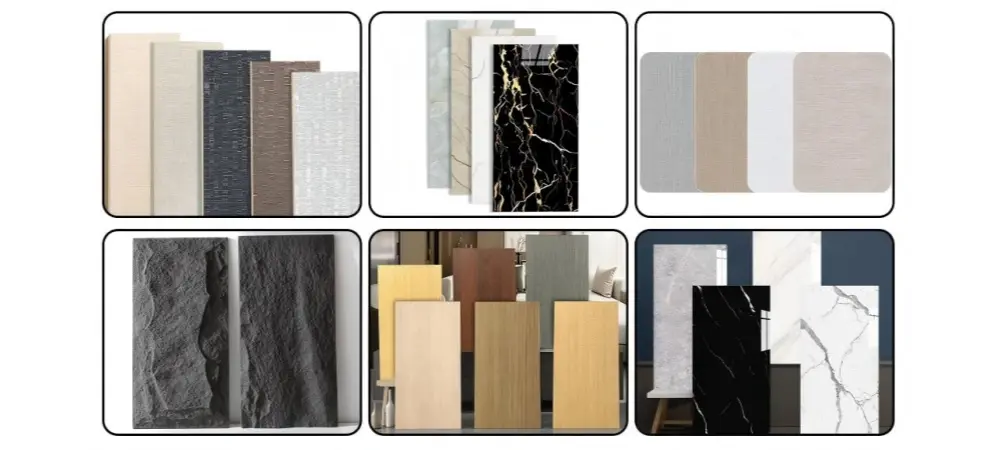
There are a lot of different finishes for PVC interior panels, such as flat, textured, gloss, matte, glossy, and lamination. These finishes can be used in both businesses and homes. MDF panels can be used in many different ways when they are dry, but they can't handle humidity and water well, so they can't be used in kitchens, bathrooms, or other wet areas in businesses.

Performance and Durability Comparison
Moisture Resistance: Where MDF Falls Short
MDF easily soaks up water. It swells, warps, and loses its structural integrity over time when it is in places with a lot of humidity. On the other hand, PVC interior panels don't absorb much water, so it's a good choice for wet repair areas like kitchen backsplashes and bathroom wall panels.
The thickness of our PVC interior panels ranges from 4.8mm to 7.5mm (standard stock) and from 5mm to 10mm (customized choices from 3mm to 15mm). The sizes are 300mm, 400mm, and 600mm, but we can also make them to any size. The length is between 2,400 and 3,000 mm, and it can be cut to fit the needs of the project. These measurements are good for all kinds of business fit-outs and home improvements that don't need a lot of complicated fabrication.
Fire Safety and Compliance Standards
When buying things for commercial construction, fire resistance is a must. Without extra cleaning, MDF pieces usually have low fire ratings. Our PVC interior panels are classified as B1 flame-retardant under EN 13501-1. They also have CE, SASO, and B1 certifications that meet Middle Eastern commercial building rules. This is an important compliance checkpoint for project creators and wholesalers in the region.
The panel has a B1 rating, which means it can put out fires on its own and makes controlled smoke levels that meet S1 smoke production standards. This means that harmful fumes are less likely to be released during fires. This standard directly supports the safety needs of places like schools, hospitals, and hotels where protecting people is very important.
Installation and Maintenance: What You Need to Know
PVC Panels Reduce On-Site Labor Time
Cutting, priming, and sealing MDF panels with great care is necessary for installation, especially in wet areas. Any hole or crack in the seal lets water in. The tongue-and-groove method in PVC interior panels, on the other hand, makes fitting quick and easy on-site. This cuts down on the need for skilled workers and speeds up the time it takes to hand over the project, which is great for repair companies who are already on a tight schedule.
For professional builders, PVC interior panels are the best choice because they are easy to place and dont need much upkeep.
- Tongue-and-groove interlock eliminates the need for extra glue on every joint, which makes installation much faster for large surfaces.
- Smooth, non-porous surfaces only need to be wiped down once in a while for maintenance. They don't need to be sealed, sanded, or painted over and over again like MDF surfaces do.
- Mold and mildew resistance is built into the material structure, so PVC interior panels can be used for walls in bathrooms, kitchens, and basements without any extra chemical treatments.
- Lightweight panels at 2.8–3.5 kg/㎡ lower the structural load on walls and make it easier to move materials during installation in business buildings with more than one floor.
These benefits directly address the problems that repair workers have when they have to meet tight deadlines and make sure that the materials used in every part of a big project perform in the same way. We also give buyers and contractors useful installation tips for humid zone wall panel projects to help them get the job done right from the first panel.
Cost and Procurement Considerations for B2B Clients
Evaluating Total Cost Beyond Unit Price
In some markets, MDF panels may have a cheaper initial unit price. However, the full cost of procurement includes how often they need to be maintained, how often they need to be replaced, how much work is needed for installation, and the risk of freight. PVC interior panels that come from a factory-direct supply chain have lower markups at the middle level and last longer—usually 15 to 20 years—without needing to be refinished. [3]
From a wholesale procurement standpoint, our PVC interior panels offer these supply chain advantages worth evaluating:
- Multi-port stocked inventory speeds up both FCL and LCL delivery, allowing for quick small wholesale spot shipping without having to pay extra for longer wait times.
- 42 standard colors in stock support fast order dispatch, while custom color sampling completes in 7 days—ideal for regional wholesalers who want to keep up with Southeast Asian interior design trends.
- Free OEM private label and customized outer carton design help online sellers and private label brands build their brands without having to spend money on tools.
- Full matching skirting boards and grilles can be bought in bulk from a single source, so you don't have to go to other suppliers for accessories.
- 30 years of PVC manufacturing experience behind our production ensures the quality of our finished products stays the same from batch to batch and order to order.
Beyond pricing, procurement teams benefit from free samples that let them directly test how waterproof the product is before placing large orders. This is something that is highly suggested when vetting new suppliers. [4]
Decision Guide: Which Panel Should You Choose?
MDF panels can still be used for dry interior spaces where being able to paint the surface is the most important thing. For example, they can be used for feature walls in an office, exhibition display boards, or the fronts of furniture in climate-controlled rooms. They have a smooth surface and can be used with many colorful films that are stuck on with glue.
PVC interior panels are the better B2B option for places that are likely to get wet, business buildings that have to follow fire codes, and projects that need to be installed quickly on a large scale. They meet all modern commercial specification needs with their B1 fire-retardant performance, zero water absorption, four surface finish options (gloss, matte, frosted, and lamination), and certifications such as CE and SASO.
Importers and dealers who do business in more than one area can also benefit from PVC interior panels because they are easier to ship. Pallet sea packing keeps products safe during long-haul freight, and stocking multiple ports lowers the risk of customs delays in key regional markets.
Conclusion
In the end, where the panels will go and what they need to do determine which is better: MDF or PVC interior panels. For dry, controlled environments, MDF works well enough. PVC interior panels are the more long-lasting and cost-effective investment for everything else, including wet areas, fire-regulated buildings, commercial spaces with a lot of foot traffic, and projects where maintenance costs are important. PVC is the best choice for most modern interior uses for B2B buyers who care about material lifetime value, source stability, and compliance standards.
FAQ
1. Are PVC wall panels suitable for bathroom and kitchen installations?
Yes. The rate at which PVC interior panels absorb water is very low, so they can't be damaged by the high levels of moisture in bathrooms and kitchens. MDF grows and separates when it's damp for a long time, but PVC stays the same size and doesn't let mold grow. For wet repair areas, our panels with a thickness of 4.8 to 7.5 mm are the best choice.
2. Do PVC panels comply with fire safety standards for commercial buildings?
As per EN 13501-1, our PVC interior panels are flame-resistant up to level B1. They also have CE and SASO standards. They are built to meet the fire codes for business building in the Middle East and are made with smoke suppressants to keep toxic fumes to a minimum. Because of this, they can be used in hospitals, schools, hotels, and stores.
3. Can I order custom sizes and colors for large commercial projects?
Yes. Panel sizes come in 300mm, 400mm, and 600mm, and lengths range from 2,400mm to 3,000mm. Custom cuts can be made for each job. It takes 7 days to finish a custom color sample. For sales of a certain amount, OEM private name and customized cartons are provided at no extra cost.
4. How do I verify product quality before placing a bulk order?
We give buyers free samples to try before they commit to buying in bulk. Immersion in boiling water for 4–8 hours, UV aging, and peel strength testing are all recommended as verification tests. These tests show that the waterproofing is good and that the lamination will last in real-world project conditions. [6]
Partner With ZX for Reliable PVC Interior Panels
ZX at zhongxiudecor.com is your trusted PVC interior panels supplier backed by 30 years of manufacturing expertise and factory-direct pricing. Our CE/SASO/B1-certified panels, 42 stocked colors, 7-day custom sampling, and free OEM labeling give your procurement team a measurable edge. Matching skirting and grilles complete your one-stop order. Contact us at info@kangdishi.com to request free samples or a tailored quote today.
References
1. Freedonia Group. (2023). Building Products: United States. The Freedonia Group. https://www.freedoniagroup.com/industry-study/building-products-united-states-3823.htm
2. European Committee for Standardization. (2018). EN 13501-1: Fire Classification of Construction Products and Building Elements. CEN.
3. Grand View Research. (2024). PVC Wall Panels Market Size, Share & Trends Analysis Report. Grand View Research. https://www.grandviewresearch.com/industry-analysis/pvc-wall-panels-market-report
4. International Trade Centre. (2022). Quality Management in B2B Procurement: Best Practices for Building Materials. ITC. https://www.intracen.org/publications/quality-management-b2b-procurement
5. SASO (Saudi Standards, Metrology and Quality Organization). (2023). Building Materials Certification Requirements for the GCC Market. SASO.
6. ISO. (2015). ISO 9001:2015 Quality Management Systems — Requirements. International Organization for Standardization. https://www.iso.org/standard/62085.html
Online Message